-
 Javy Wang
Microsoft (US)
Principal Product Designer
Javy Wang
Microsoft (US)
Principal Product Designer
Javy Wang is a Principal Product Designer at Microsoft, working on Azure cloud and developer tooling experiences, and exploring the intersection of AI, product design, and builder workflows.
With 12+ years of product design experience across Microsoft and IBM, she focuses on translating complex enterprise and AI capabilities into usable product experiences. Her public sharing focuses on generalizable design methods, publicly shareable learnings, and personal AI-building experiments, without disclosing Microsoft confidential information.
Outside of her full-time work, Javy explores designer-led AI prototyping and product-building workflows through personal projects and public writing. Her work discusses how designers can use AI tools to move from concept to prototype, strengthen product judgment, and better collaborate with engineering and product teams.
This session reflects personal experience and publicly shareable methods only. It does not represent Microsoft’s official position and does not disclose Microsoft confidential information.
-

Song Xiaoyue Xiaomi Group Design Lead, Global Internet Department
-

Wang Suqing McDonald’s (China) Director of Customer Digital Products
-

Tang Yi Amazon Senior UX Designer
-

Zhang Qiu 360 Group Head of UXC User Experience Center
How AI Workflows Are Reshaping the Way Design Teams Work — A Cross-Industry Roundtable on the Future of Design Organizations
Over the past two years, AI tools have rapidly evolved from individual productivity aids into team-level collaboration infrastructure. As Figma Make, Claude Code, Cursor, and the MCP Protocol become embedded in designers' daily workflows, a deeper question is emerging — this is no longer a personal choice about "should designers learn AI tools?" It is a structural shift in how design teams are organized, how they collaborate, and where role boundaries lie.What is actually happening on the ground: some teams have multiplied design output by 3–5× with AI, only to find themselves trapped in a new dilemma of abundant output, insufficient judgment. Some design leaders are quietly redefining designer KPIs — shifting from volume of deliverables to density of judgment. Some organizations are dismantling the traditional handoff chain between PMs, designers, and front-end engineers, stitching together new AI-powered collaboration flows. And some teams, after experimentation, have chosen to return to traditional workflows because the rework and communication overhead outweighed the gains.This is not a showcase of "how powerful AI tools are." It is an honest, on-the-ground conversation. We have invited design leaders and practitioners from companies of different sizes, industries, and organizational structures to explore four core questions together: What does workflow reconstruction actually look like? How are team roles evolving — and where do they clash? What is the new balance between speed and quality? And what systemic challenges are emerging at the organization level?This roundtable will not shy away from disagreement. We believe the most valuable insights come from the collision of different answers, not from reinforcing a single viewpoint. Whether you are a design leader navigating team transformation, an IC designer reshaping your own workflow, or a cross-functional leader seeking to understand where design organizations are headed, this conversation is meant to give you a starting point for your own thinking — not a ready-made answer.
1、Round‑robin sharing of publicly shareable, anonymized, or generalized cases: Which workflows have been restructured by AI? (Motivation, approach, quantitative changes, remaining challenges)
2、Panel debate: Does AI amplify or dilute design value? Core topics for debate:
"Does AI make designers more strategic or more replaceable?"
"With output speed increased tenfold, is the core value of a designer judgment or taste?"
"With AI here, should teams grow larger or smaller?"
3、Organizational evolution: The future form of design teams — focusing on systemic issues (hiring criteria, KPI systems, redefining collaboration boundaries)
4、One‑sentence advice: Each panelist gives their most hard‑hitting piece of advice to teams undergoing transformation
5、Open mic + free discussion (audience participation)
1、Design leaders (Directors/VPs/Heads): Those who wish to learn from the real‑world pitfalls of their peers and redesign KPIs, collaboration processes, and team structures.
2、Frontline designers: Those who have already felt the impact of AI and want to see the next step in their career path.
3、Product managers & front‑end engineers: Those who seek to redefine the collaboration interface with design teams.
4、Observers of the design industry (education, recruitment, consulting): Those who need to understand the shape of next‑generation design teams.
1、A library of real‑world case studies. Complete cases of AI workflow restructuring from design teams of varying sizes and industries, including successful paths, failed attempts, measurable efficiency changes, and the real organizational challenges they faced — offering more valuable insights than theoretical analysis.
2、Multiple perspectives on the evolution of design organizations. Honest debates from different standpoints on core issues such as "Does AI make designers more replaceable?", "The new balance between efficiency and quality", and "Changes in team size and structure" — helping the audience form their own judgments rather than accepting a single answer.
3、Actionable entry points for team transformation. A concrete toolkit for design leaders and cross‑functional managers in the AI era — including ideas for redesigning KPIs, updating hiring criteria, and rethinking collaboration workflows — which can be directly brought back to their teams for experimentation.
4、Critical judgment for the next phase. By observing how frontline leaders think about systemic issues, participants will build their own judgment about the future direction of "AI × design organizations" — an ability that is more important than any specific tool or technique, and far harder to be replaced by AI.
-
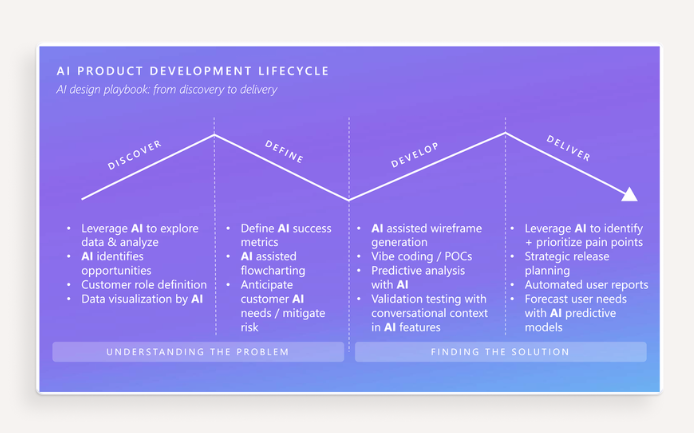
 AI Product development lifecycle
-
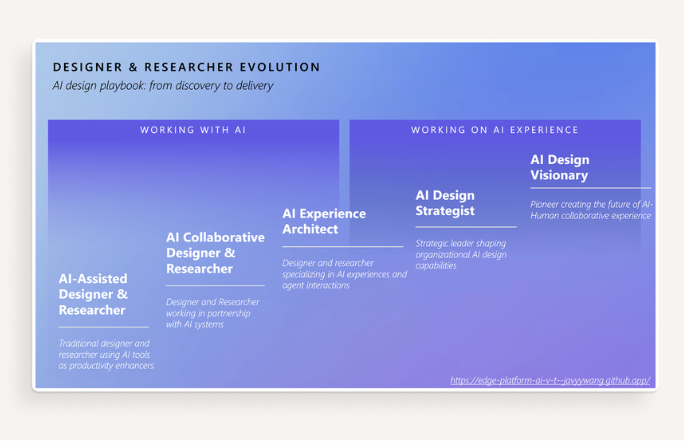
 UX evolution
-
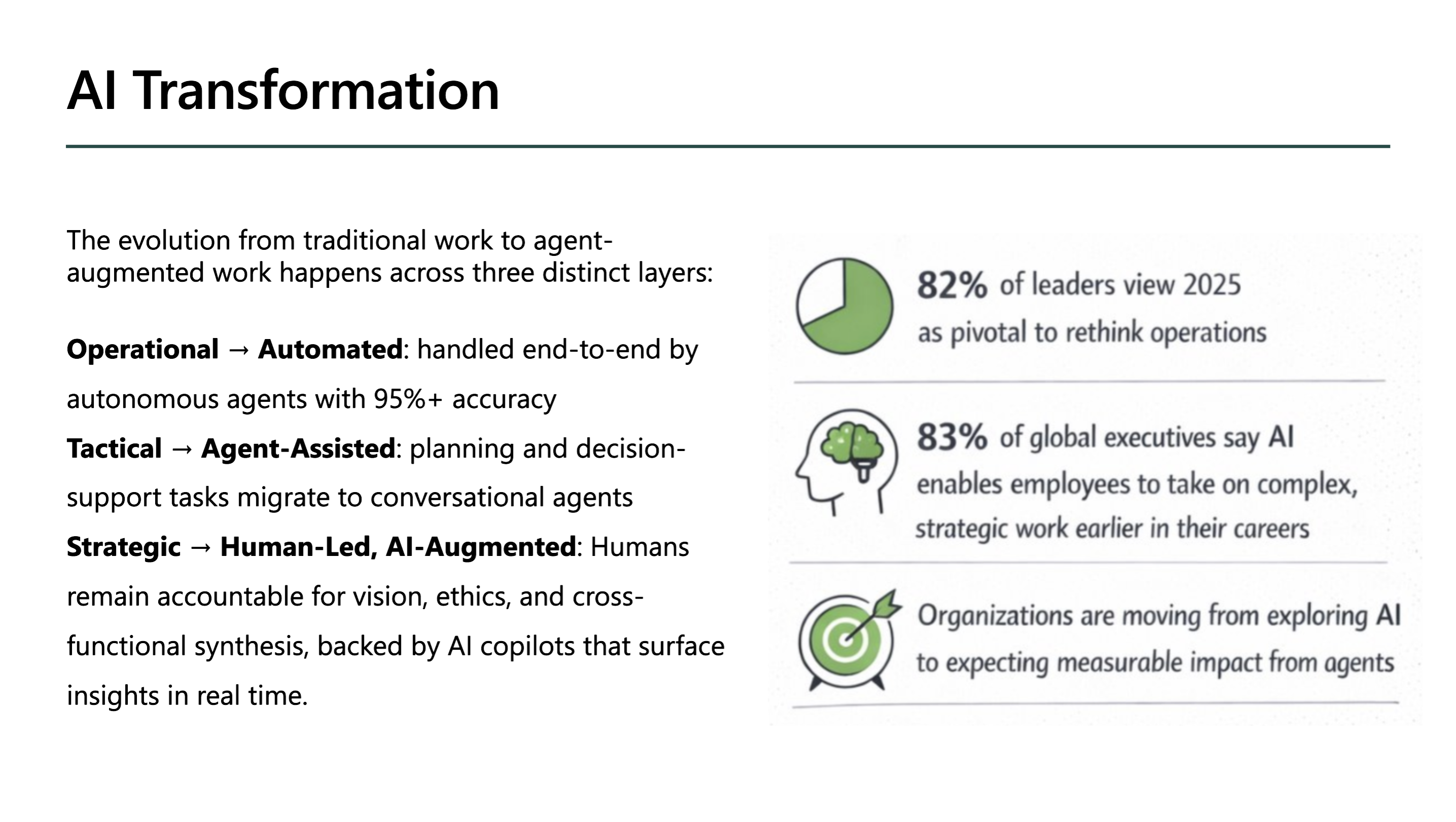 AI transformation