-
 Tang Yi
Amazon
Senior UX Designer
Tang Yi
Amazon
Senior UX Designer
Yi Tang is a Senior UX Designer at Amazon, specializing in enterprise systems, AI-assisted workflows, and human-centered experiences for high-stakes decision-making environments. His work spans global HR platforms, electric vehicle service operations, research data systems, and complex decision-support tools, with a focus on translating complex workflows, data, and AI capabilities into clear, trustworthy, and actionable product experiences. Yi is particularly interested in transparency, human judgment, compliance-aware design, and organizational efficiency. He has published professional writing on high-stakes enterprise workflow UX in UXmatters, and his work has been recognized by international design awards including the German Design Award, MUSE Design Awards, and A’ Design Award.
Three-Layer Design Context: Bringing AI into Design Decisions
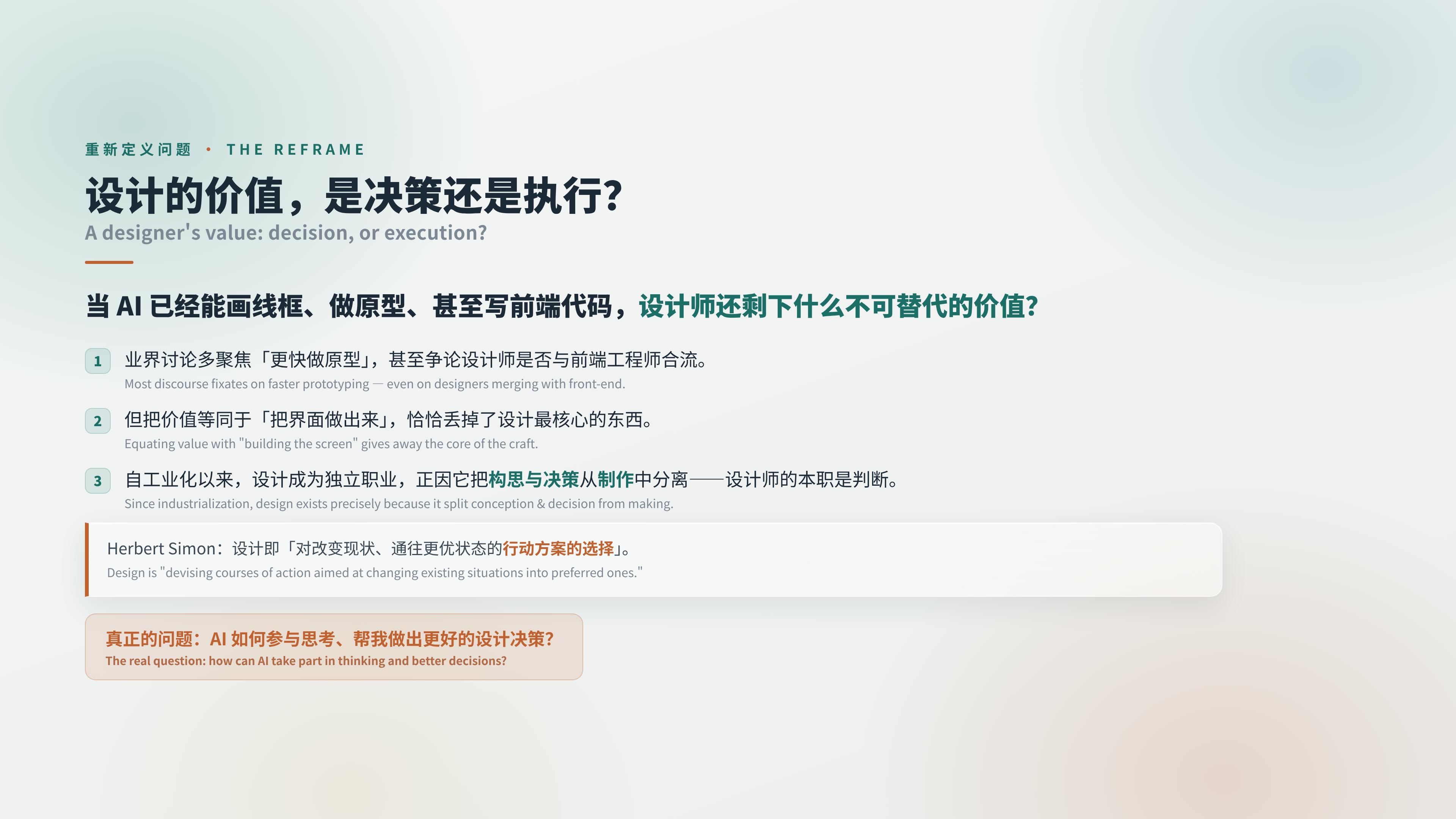
When AI can already sketch wireframes, build prototypes, and even write front-end code, what irreplaceable value does a designer still hold?
Most of today's “AI + design” conversation is about producing prototypes faster—some even debate whether designers will merge with front-end engineers. But equating a designer's value with “getting the interface built” gives away the very core of the profession. Ever since industrial production, design became a distinct discipline precisely because it separated conception and decision-making from making itself: a designer's real job is judgment, not execution. Herbert Simon, in The Sciences of the Artificial, defined design as “devising courses of action aimed at changing existing situations into preferred ones.” So the question worth exploring is not “can AI build my prototype,” but “how can AI take part in my thinking and help me make better design decisions?”
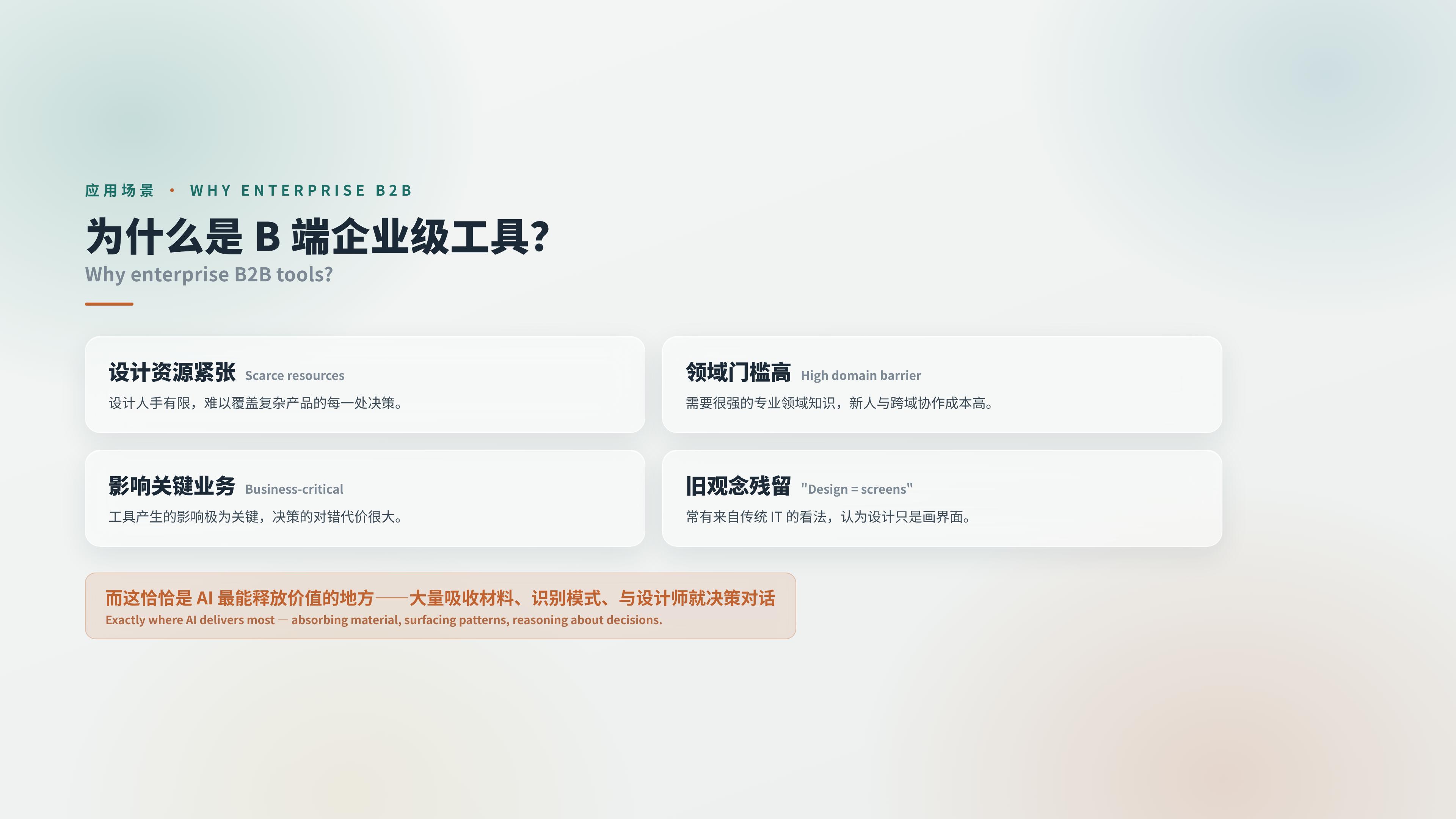
This matters most in B2B enterprise tools: design resources are scarce, domain knowledge is demanding, the tools carry critical business impact, and legacy “design is just drawing screens” attitudes often linger. That is exactly where AI shines—it can absorb large volumes of material, surface patterns, and reason with the designer about decisions through dialogue.
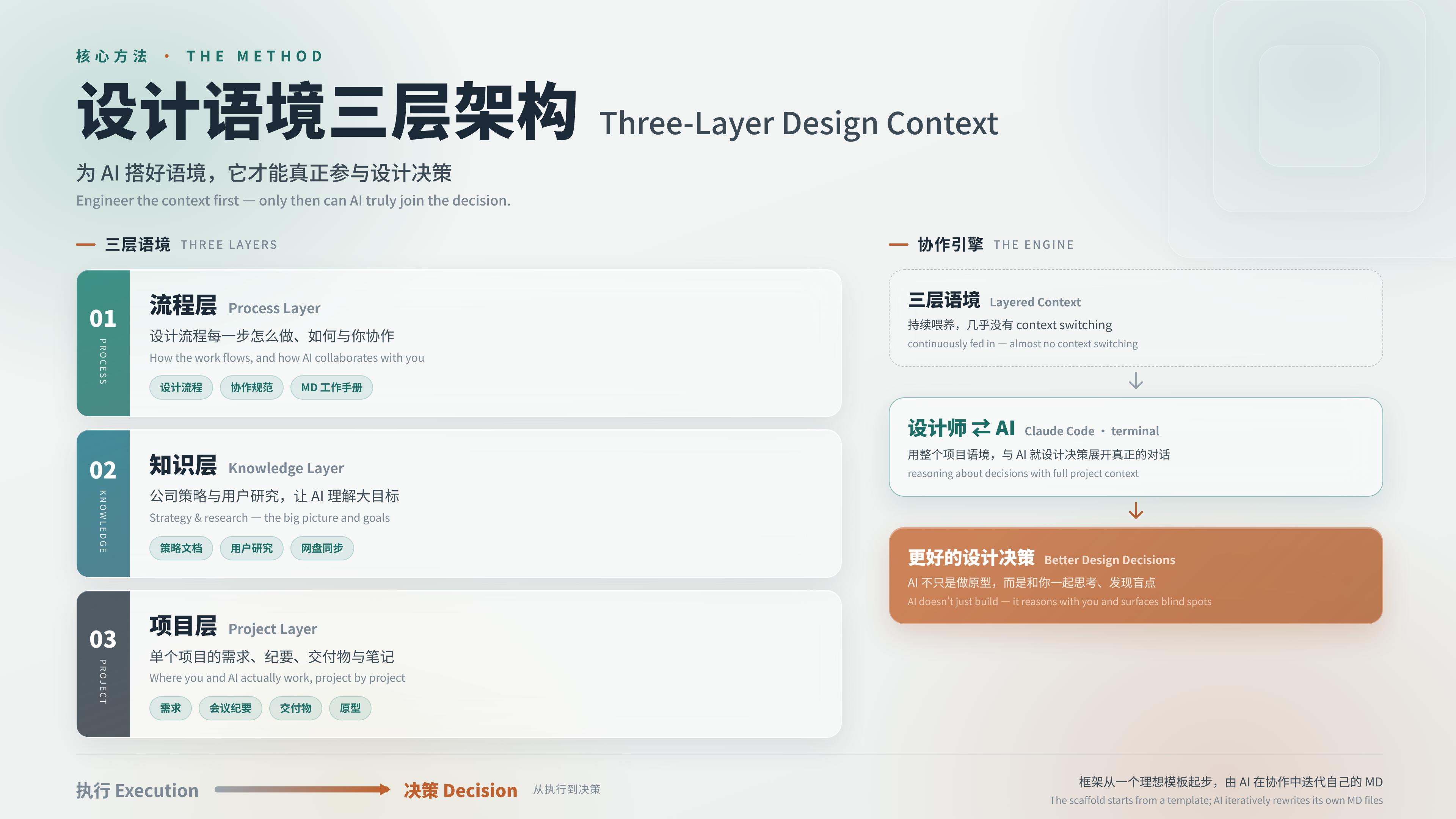
This workshop shares my practice of building an end-to-end AI collaboration workflow with Claude Code on enterprise projects, centered on a “Three-Layer Design Context” method:
·Process layer — write your design process (each step, how, what to watch for) so AI knows how to collaborate with you;
·Knowledge layer — sync company strategy and user research so AI understands the larger goals;
·Project layer — a single project's requirements, meeting notes, deliverables and notes, where you and AI actually work together.
Above these layers, AI continually revises its own “manual” (MD files), making collaboration smoother with almost no context switching.
Using real (sanitized) cases, we will see how AI reconstructs a PM's true intent from vague requirements, distills user flows under time pressure, generates domain-accurate content for prototypes, and helps catch overlooked decisions (e.g., whether to show a “meaningful zero”).
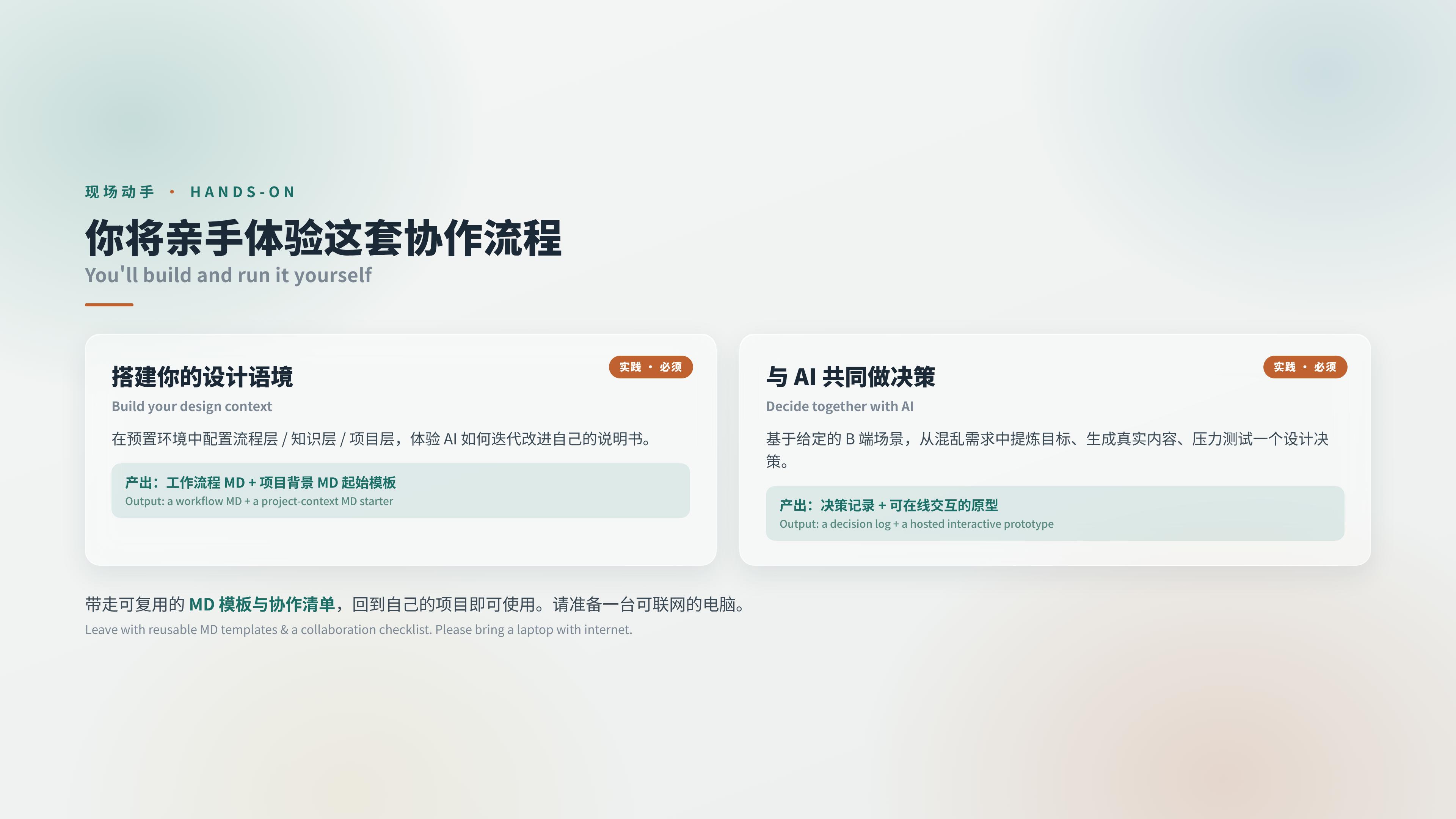
On site, you will enter a pre-configured AI environment, experience this workflow hands-on, and leave with a reusable method and templates. Please bring a laptop with internet access.
1、Opening & quick AI-term alignment: speaker background, workshop goals; a fast refresher on LLMs, context window, agents, Claude Code / terminal, MD files.
2、Reframing the problem: design's value is decision, not execution: starting from design history and Herbert Simon; the blind spots of today's “AI + design” discourse; the B2B enterprise design context and its challenges.
3、Methodology: the Three-Layer Design Context: building the process / knowledge / project layers, and how AI iteratively improves its own manual; live demo.
4、Build your design context: configure the three layers in a pre-set environment. Output — a workflow MD + a project-context MD starter.
5、Make design decisions with AI: on a given B2B scenario, distill the true goal from messy requirements, generate domain-accurate content, and stress-test one design decision. Output — a decision log + a hosted interactive prototype.
6、Group share & feedback: focused on “how AI helps surface blind spots and reach better decisions.”
7、Wrap-up: from executor to decision-maker: a collaboration checklist, next steps toward AI governance, and templates to take home.
1、Senior / Lead Experience & Interaction Designers
2、Design Managers & Design Leads
3、B2B / Enterprise Product Managers
4、Design leaders & DesignOps driving AI adoption
1、A reusable “Three-Layer Design Context” method that upgrades AI from a prototyping tool to a design-decision partner
2、How to configure project context for AI, cut context switching, and make end-to-end collaboration genuinely smooth
3、How to use AI in vague-requirement, complex-domain, time-pressured B2B settings to distill user flows, generate realistic content, and stress-test design decisions
4、How designers step into AI governance and partner more deeply with PMs and business stakeholders
5、MD templates and a collaboration checklist ready to use on your own projects